
Journaling Symptoms - Why do it, How to do it and a Flood of New Apps
Logging and tracking symptoms to spot patterns is invaluable for chronic, fluctuating conditions like Meniere's - is there a "best" way?

Human memory is a slippery subversive thing. We can be so sure about what we remember, and it can turn out to be entirely wrong. We are unreliable tellers of our own story. This is as true for eye-witness testimony in court as it is for telling your doctor how you’ve been since you last saw them, or remembering how your symptoms were this time last year. We think we know, but we’re often wrong. This is especially tricky if you have a wildly fluctuating, multi-symptom condition like Meniere’s disease.
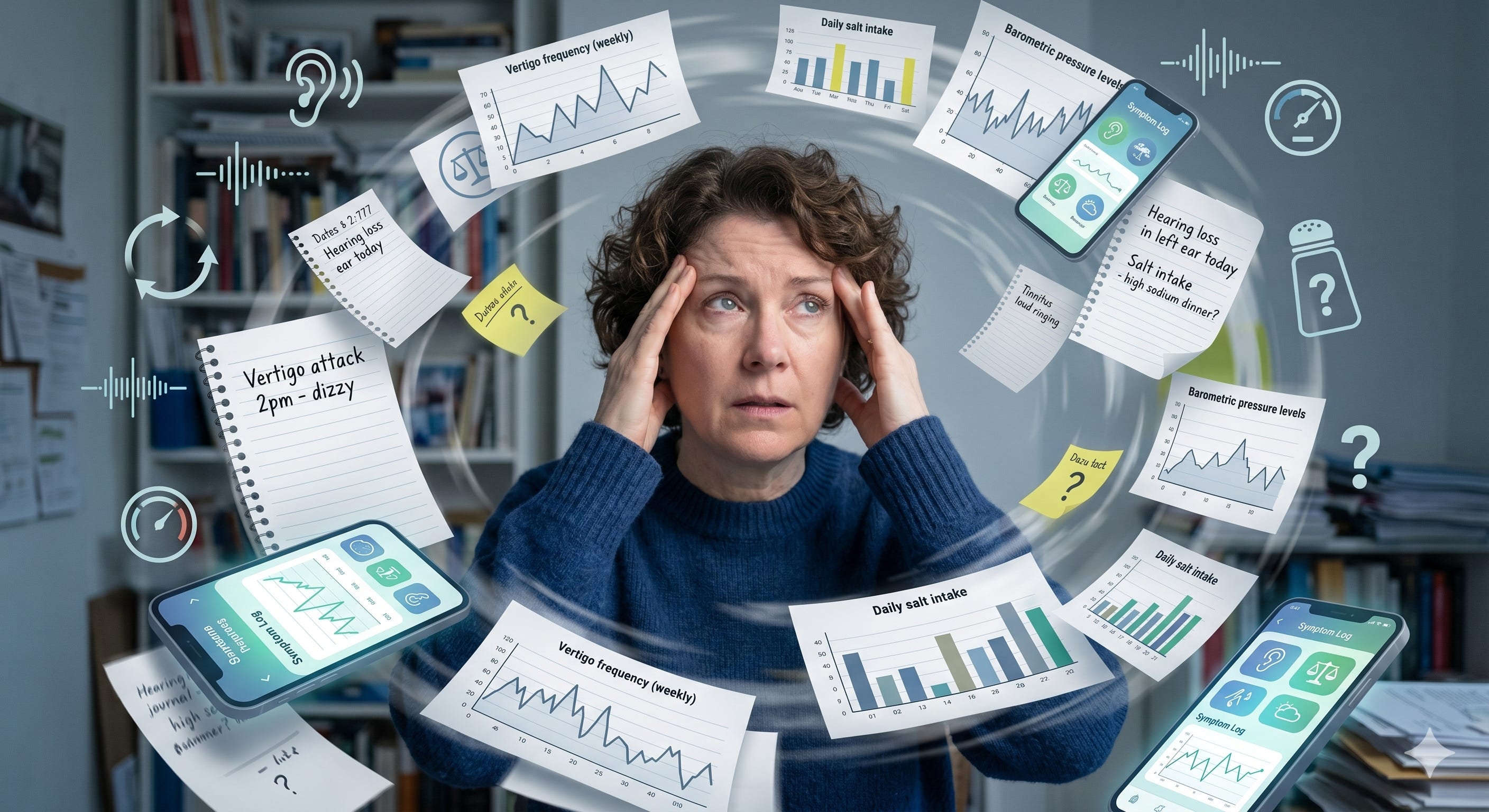
It is for this reason that it is highly recommended for sufferers of conditions like Meniere’s to habitually log or journal their symptoms. This gives a record of how you really felt and can be incredibly valuable in many different ways. First it is a great document to take to doctors appointments - when they ask that dreaded opener “So, how have you been?” you can either use your log as a reminder to talk over what has been happening, or if it is readable enough just hand it over for them to scan through. It is also very useful if you start taking a preventative medication like a diuretic or Betahistine - after a few months on the new treatment you can look back and see if things really have changed. It was my journals that convinced me that Betahistine was not actually helping even though I had felt maybe it was. The facts were there - I was having roughly as many attacks as before and symptoms overall from my log did not seem better.
Dave Giugno who helps run a large Meniere’s support group on Facebook and also has a YouTube channel dedicated to his Meniere’s experiences has pointed out to me how useful journaling was to him in applying for Social Security Disability Insurance (SSDI) - something I had not considered but I can see it would be essential evidence for a case.
A final big use of journals is in spotting potential triggers. In the first instance you can just look back over your records and see if you can spot patterns - maybe comparing with records of the local weather and pressure changes, or seeing from your diary when you went out for a big restaurant meal that might have been loaded with salt or involved over imbibing alcohol. You could then take the journal one stage further and also separately log things you suspect are triggers, such as salt or caffeine intake. Dieticians suggest however that you do this more methodically - having logged symptoms for some time, exclude one thing that you consider may be a trigger for a few weeks, then reintroduce it and see what changes. Repeat with other potential triggers. If you want to hack this process to speed it up, you can eliminate all the suspect triggers (as much as is feasible - salt should not be reduced too low) for a few weeks or months, then reintroduce things one at a time over a long period. In all cases, the journal is your bedrock, the reference you will go back to again and again to see what has been happening and remove the uncertainty of your own fallible recollection.
So we need to be tracking our symptoms. What should we track and how? Consistency is key so doing too much will likely undermine your efforts and result in you not sticking to the journal. Given that the essential defining symptoms of Meniere’s are tinnitus, feeling of fullness in the ear and hearing loss plus bouts of vertigo, these seem like the things to track. I found that fullness and hearing loss tended to go together so I never bothered with fullness. Every day, sometimes more than once a day, I would try to write down a number for my sense of how much hearing loss and tinnitus I had on a scale 0-9 and also any attacks of vertigo with a “time spent in bed” and any medication taken. As soon as it became clear I was having problems with both ears I included a measure for tinnitus and hearing loss for each ear. The hearing loss I judged by rubbing my fingers together and moving them away until I could no longer hear the sound, just to give a rough and ready measure. I also added notes about anything else significant, subjective feelings or notable events, but these ended up being much less useful than the changes in the symptom measures. It soon became clear from this kind of journaling that I had a classic pattern - the hearing symptoms worsening for some days or weeks followed by bouts of vertigo after which things would improve. It was also clear that the flares came in clusters with longish periods of remission in between.
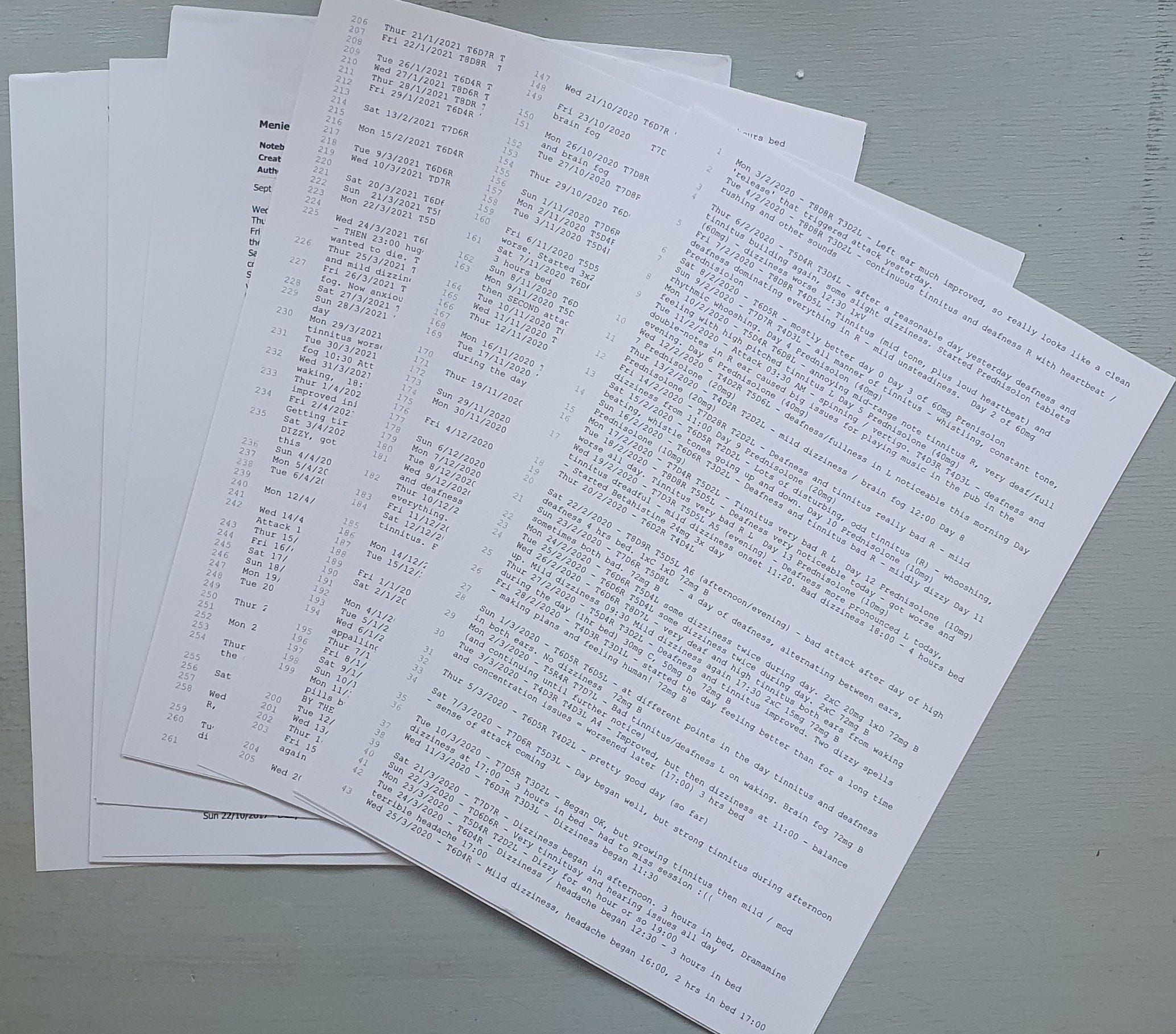
I kept my journal in a simple text file on the computer. If you prefer pencil and paper, Meniere’s sufferer and advocate Juliann Wallace has published the Daily Meniere’s Journal which you can find online, or if you message me I can send you a pdf copy. You could of course also use a spreadsheet or notepad on the PC or phone and these days cloud services will allow you to access files from multiple devices and keep them backed up. For a long time I thought some kind of app would be a nice idea and I tried a few over the years but they were all too complex and typically not tuned for Meniere’s. I used to be a software developer and had begun sketching my thoughts for my own app. Then all of a sudden in the past few months, a whole raft of new apps have appeared. I have seen at least five. I suspect the reason why may in part be down to Artificial Intelligence. AI coding has reached a point where it is much easier for someone with an idea to turn it into an app. This isn’t to say you don’t need skills - you do - setting up development environments is still a complex task. However the barrier to entry is lower and the speed with which something useful can be produced much less. So we suddenly have a lot of tracking and monitoring apps available or on the way. At some point I intend to review them, but at the moment they are mostly in my view incomplete and along with other people I am providing feedback to as many developers as I can. So rather than review any individual apps I wanted to list what I see as the useful features and where for me the apps are currently not quite there. This is of course my personal view and your needs from an app may well be different. I’d love to hear from you in the comments what you would like from a tracking or symptom journaling app.
It seems to me that there are three main focuses for tracking apps. First we have simple symptom logging like Menierly - open the app, click a few buttons to indicate your current symptoms and save. Then there are apps centered around doing a detailed hearing test - the authors of the Vestia and Meniere’s Biometrics apps want to make sure you understand that is their key focus. Finally there are apps that allow you to also track potential triggers - mainly sodium and barometric pressure, and even use that to predict when you might have an attack of vertigo. Balance:Vestibular Diary is in this category. Some apps mix all these approaches.

For me, the features of an ideal app should start from the classic presentation of the disease. There is a constant rolling landscape of fluctuating symptoms in Meniere’s - this is daily life for sufferers - decreases in hearing, increases in tinnitus, maybe the onset of balance issues. Layered on top of that are the spiky peaks (or maybe dread-laden valleys) of vertigo attacks. It is the shape of this landscape that I believe is the most useful thing. That means being able to consistently, quickly, note down key symptoms once or twice a day. Automated reminders are hugely helpful with this - I use an app called Daylio for mood tracking that has nailed this. I want a simple page where I can with one tap enter a subjective level for key symptoms for each ear. One value for left, one for right. I want not only a date but a time so more than one can be entered per day, and a way to edit them in case of errors or needing to add entries later (attacks can render us incapable of using any technology for a while). Attacks of vertigo should also be loggable including some way to estimate severity (I used hours spent out of action as my proxy measure) and rescue medication taken. With each log entry, an optional notes field would allow any special circumstances to then be added via text or voice. As far as essentials go, I’d then need to be able to see this data in a list, table or graph - spotting patterns is what we are good at but only if the information is presented in the right ways. This kind of ability to view the data in many ways is the main reason I always wanted a digital form of my log. Summaries of things like average attacks per week or month are also useful as is the ability to export or print the data for taking to a doctor.
Beyond that, for me personally, everything added needs to justify itself. Is it worth the extra complexity? Automating the process of adding the local weather or barometric pressure to the log might be valuable, as could be adding the amount of sodium consumed in the previous 24 hours if that data were available, maybe by syncing with a diet or fitness app. Trying to log potential triggers at the same time as symptoms doesn’t make sense to me - triggers need to be independently logged and then checked against the journal to see patterns. I’m not in favour personally of attempts to predict attacks. Firstly there is to my knowledge not enough good quality evidence in general of the impact of either pressure changes or diet to be able to do this kind of prediction across the board for any patient. There is also a big risk - that the prediction becomes self-fulfilling as anxiety and expectation play a significant role in conditions like tinnitus and vertigo as we saw last time:

One possible way that prediction could, maybe, make sense is if there were enough data on both symptoms and environment (logged separately) to then apply some AI pattern searching algorithms to the make an tailored, personal prediction. This could form the basis for an interesting research project. It would be very hard to do cleanly in a way that avoids bias but I think might be possible to at least determine if the idea has merit. However we aren’t there yet and apps saying they can already make predictions are, for me personally, making unsubstantiated claims.
What about hearing tests in apps? This is an evolving area. The iPhone paired with AirPod2 earpieces is capable of carrying out an FDA-approved hearing test which can then be used to set up the AirPods to compensate for hearing loss, so the idea of using the phone for measuring hearing is reasonable. The challenge with other phones and earpieces is that they are all going to produce different volumes and have different frequency characteristics. However as long as you use the same hardware each time and the same volume on the phone, you should at least be able to spot changes by doing at home measurements regularly. I can see some value in this. I am in the lucky position of having very regular professional hearing tests from my audiologist, but for those of you who aren’t, at home measurements through an app could be useful. The challenge here is the ease of use - I have tried these apps and found them very hard to get consistent results with and one hearing test could take from 5 to 10 minutes. But I’m open to being persuaded of their value - I’d certainly find the results interesting - to be able to see how the hearing fluctuates in detail every day could reveal a lot about how the fluid in the ear is changing and might even be a potential diagnostic tool. It has to be super easy to use for this to work though.
Journaling your symptoms, however you do it, is an invaluable part of your Meniere’s self-care. It is great that so many new apps are appearing, and we should end up with some truly useful tools to support the approach that best suits each of us. I’d love to hear from you about your experiences with monitoring and tracking your symptoms - what would you like to see in these apps? I know the developers are listening :)
A selection of apps under development
Menierly: Meniere’s Toolkit https://menierly.com/
Balance: Vestibular Diary https://alchemyg.com/balance-app/
Meniere’s Biometrics https://www.menieresbiometrics.com/
Vestia https://vestia.health/
AI Statement
No AI was used in the production of the text for this article. AI is sometimes used to assist researching areas but none of the resulting text is used. AI image generation has been used to produce or augment some images.
Excellent advice, Neil! I have kept journals for years and found them helpful when sharing with family or doctors. Journals also help with understanding triggers and effectiveness of medications. Thanks for your great work on this!